Showing posts with label newsletter. Show all posts

Spring 2009 Newsletter

Friday, May 1, 2009

In this issue:
Turtle Handling 101
Volunteer Positions at the KTTC
An Updated Herpetofaunal Atlas for Ontario Beginning in 2009
Spotlight on the Spotted Turtle
Precious Little Turtles on the Brink
Turtle Myths Busted
Understanding the Endangered Species Act 2007
Turtle Crossing Signs
Legend's Babies


Turtle Handling 101
By Brooke Bays

Why did the turtle cross the road? To get to the other side! Spring is just about here and turtles will once again be braving our roadways and dodging our lawnmowers. Although wild animals are usually best left alone, sometimes they need our help and there is, of course, a proper way to do so. The following tips will assist in making sure both you and the injured turtle get through the rescue mission safely.


  • Before anything else, make sure it is safe for you to pull over and help the turtle in need!
  • If you are helping an uninjured turtle off the road, always be sure to move the animal in the direction it is headed – even if it is travelling away from the nearest source of water. The turtle may be on its way for a traditional nesting site or hibernation area.
  • Species such as painted turtles or Blanding’s turtles can be picked up by the shell and placed out of harm’s way.
  • Be careful helping a Snapping Turtle across the road – keep a safe distance from their head as they will snap at you if they feel threatened. An uninjured animal can be coaxed across the road using a shovel or a board, or by allowing it to bite a long stick and pulling it across the road. Never pick up a turtle by the tail; you may damage its spine.
  • If you must pick up a snapping turtle by hand, do so by sliding fingers behind the turtle's hind legs, with the tail between your hands and gripping the shell between your fingers and thumbs. You may also slide one hand under the turtle’s belly to grab a hold of the plastron (the belly shell). Snappers are very strong and will squirm and thrash their hind legs making it difficult to hold on. A Snapper cannot reach all the way to its tail, despite popular belief, but can reach about half way.
  • If you find an injured turtle and would like to bring it into the KTTC or another rehabilitation centre make note of the location where the turtle is found. Once the turtle has recovered it will need to be returned to its territory and the information will be useful in determining mortality hotspots.
  • Injured animals should be carefully placed in a clean, well-ventilated container with a lid (so they don’t crawl out). An injured Snapper may be placed into the container using shovel or piece of wood, or if you must use your hands, lift the turtle only just off the ground and into the container.
  • Take a damp piece of cloth and place it over the turtle’s head. This will reduce stress.
  • Do not try to offer the turtle food or water.
  • Keep the container in the shade (do not leave the turtle in a hot car in summer!)
  • Call ahead to make sure the turtle will be accepted. If you live in the Kawarthas you can check our website for our phone number and drop-off locations which will be updated once we’ve found a new location. In other areas of the province a local wildlife rehabilitation centre or vet may be able to help you.
  • Wash your hands thoroughly!

If you find a turtle that is not injured and not in immediate danger, kindly leave it be. Never take a wild turtle home as a pet!


Volunteer Opportunities at the KTTC
There are several new volunteer opportunities at the KTTC. Thre are several ways to help us help turtles:

Turtle Taxi Drivers
Fundraising Volunteers
Turtle Talk Volunteers
Turtle Times Writers
Webmaster
Building Maintenance Volunteer
Grant Writer

Or if you have another skill or talent that you'd like to share please let us know!


An Updated Herpetofaunal Atlas for Ontario Beginning in 2009
By Joe Crowley
Ontario Nature Reptiles at Risk Project Coordinator
joec@ontarionature.org


Thirty of Ontario’s forty-three species of reptiles are listed as Endangered, Threatened, or of Special Concern by the Committee on the Status of Endangered Wildlife in Canada (COSEWIC). Many of Ontario’s reptile species only occur in the southernmost parts of the province, which has become one of the most developed regions in Canada. As a result, habitat loss, roads, and other threats have caused drastic population declines, and some species have disappeared from many areas altogether. For example, the massasauga populations on the Bruce Peninsula were once continuous with those of eastern Georgian Bay, but now no longer occur south of Wiarton. The current distribution of the massasauga in Ontario is highly correlated with habitat loss and road density, suggesting that this range retraction is the result of the northward encroachment of agriculture, development, and roads in southern Ontario.

The rapid disappearance of reptiles throughout southern Ontario demonstrates the urgent need to identify and protect remaining populations. The previous Ontario Herpetofaunal Summary (OHS) Atlas has been compiling reptile and amphibian distribution data since 1984, and in that time approximately 150,000 records have been added to the database. Although the OHS database has provided an exceptional account of species distributions at the provincial scale, the locations of many populations remain unknown, and detailed information about population abundance or status is out of date in many areas.

In 2008, Ontario Nature received funding from the Environment Canada Habitat Stewardship Program, the OMNR Species at Risk Stewardship Fund, and the Metcalf Internship Program to begin a Reptiles at Risk project in Grey and Bruce counties. Populations of all at-risk reptiles in Ontario Nature’s Nature Reserves in Grey and Bruce counties were identified, important habitat was mapped, and management plans were drafted for each population. An outreach campaign was also initiated in order to increase awareness of reptile conservation, promote habitat stewardship, and reduce human persecution, road mortality, illegal collection and other threats. During Ontario Nature’s reptile work in Grey and Bruce counties, several new populations of at-risk reptiles were discovered, and it became apparent that the locations of many populations of reptiles have not been documented in this region.

Around the same time, the Eastern Ontario Model Forest (EOMF) received funding from the Environment Canada Habitat Stewardship Program and the OMNR Species at Risk Stewardship Fund to develop the methodology and framework for an Eastern Ontario Herpetofaunal Atlas and Awareness Program. An extensive outreach campaign was also developed for eastern Ontario to encourage participation in the atlas program and provide information about reptile and amphibian identification and conservation in eastern Ontario.

Through a partnership with the EOMF, the Natural Heritage Information Centre (NHIC), and other government and non-government groups, Ontario Nature is expanding the eastern Ontario atlas framework and building on the Grey-Bruce reptiles at risk program to begin an updated Ontario Herpetofaunal Atlas Program. Beginning in the spring of 2009, volunteers are encouraged to submit observations of reptiles and amphibians from anywhere in Ontario. Observation data can be reported by filling in an online form, or multiple observations can be entered into a downloadable Excel atlas reporting form and submitted over e-mail. A printable data sheet is available for participants to take into the field with them, and these completed forms can also be mailed in. Observations should be accompanied with photographs whenever possible to help confirm the identity of the species being reported. For the 2009 field season, the EOMF is holding a photo contest with monthly prizes for photos submitted with atlas observations from eastern Ontario. When conducting surveys for the atlas program, reptiles and amphibians should not be harassed or handled, and great care should be taken to avoid altering or destroying habitat. Atlas participants are also reminded to be respectful of private property and to never trespass in search of wildlife.

Groups that wish to participate in the herpetofaunal atlas program should contact Joe Crowley at joec@ontarionature.org to inquire about training workshops, volunteer survey events, herpetofaunal atlas program materials, and reptile and amphibian ID guides. Organizations with pre-existing reptile and amphibian occurrence data are encouraged to contribute their data to the atlas program as well. The data collected by the atlas will help to ensure that planning decisions, stewardship, habitat protection, and status assessments are better informed. For more information about the herpetofaunal atlas and photo contest or to submit observations, please visit the Eastern Ontario Model Forest’s website.


Spotlight on the Spotted Turtle (Clemmys guttata)
By Danielle Tassie

People who work in wildlife rehabilitation are supposed to avoid words like “cute” and “cuddly”. Wildlife in our care are just that – wild. We are not supposed to think of them as cute.

That being said, the Spotted Turtle is one cute wild animal. This is the smallest turtle you'll find in Ontario, with adults growing to just 9-12 cm long. Along with the size, you can tell it's a Spotted Turtle by the smooth, dark shell, legs and head, scattered with bright yellow spots.

The Spotted Turtle lives in Northeastern North America. In Ontario small numbers of these turtles are found near Lake Erie, Georgian Bay and along the St. Lawrence River.

Spotted turtles like small, shallow water bodies such as ponds, marshes, woodland streams, even ditches – anything with soft bottoms and lots of vegetation.

These turtles like their rest. When it's really hot in the summer, they're resting in cool wetlands or in forest leaf litter. During the “winter” (which may begin in early fall) the Spotted Turtle is dormant at the bottom of ponds and marshes (often grouped with several other Spotted Turtles).

Their one period of activity is late spring. Like many of Ontario's turtles, the female Spotted Turtle lays its eggs in late May or June. She will lay anywhere from 1-8 eggs, which hatch 60-80 days later. Like all turtles, the mother's work is done as soon as she lays her eggs. Turtles do not sit on their nests, and as soon as the babies hatch, they know exactly what to do and where to go!

Like all turtles, the little Spotted Turtle faces some big threats; habitat loss, destruction of wetlands, water pollution, and illegal collection for the pet trade. These small gentle turtles are appealing to us people, and unfortunately many wild turtles are collected and sold as pets. (So, please, never ever buy wild caught turtles!). Turtle eggs are also eaten by animals such as raccoons and skunks.

The Spotted Turtle is a “Species at Risk” in Ontario. It's Endangered in Ontario and throughout Canada.


Precious Little Turtles on the Brink…
By Steve Marks

One of my personal favourite species of reptile that lives here in our province is the spotted turtle, Clemmys guttata. It’s Canada’s smallest species of turtle, and they’re easily our most beautiful! With bright orange skin, yellow spots on a jet black shell, the cutest little faces, and spunk and personality to spare, they are one of Ontario’s true natural treasures.

Spotted turtles have a tough time of it here in Ontario. In fact, they aren’t doing well anywhere they occur. There are many pressures to this species, and very little relief in sight in a lot of the places they subsist. One real threat is collection for the pet trade. It is illegal in this part of the world to keep the species without a special permit, but elsewhere, spotted turtles can be legally bought and sold. Where they are bred in captivity, that is just fine, but the numbers produced in captivity does not feed the demand for these wonderful little turtles. Therefore, the demand for wild caught animals is very real and these turtles are collected by unscrupulous individuals looking to make a quick buck.

Where the landscape is disturbed, the species seems to be quite sensitive. Even in Provincial Parks, the disturbances that can occur are not favourable to these little turtles. From 1995 to 2002, I conducted an informal volunteer study of spotted turtles for a park. It was created in 1975. It’s not a very large area, by Provincial Park standards, and yet there were hundreds of spotted turtles living within the boundaries. Between 1976 and 1978 most of the critical habitat in the park was altered, as the campgrounds and other recreational areas were developed. Family camping became the primary function of this little park, and today it boasts several hundred sites, most of which occur in previously occupied spotted turtle habitat.

As the years went by, another huge pressure for today’s turtles emerged in full force. Predator populations were being rapidly subsidized. Campers unknowingly (or consciously) feed raccoons, creating more body fat in the adults, which therefore produce more young. The population flourishes, only to put more pressure on whatever species the raccoons naturally prey upon. So, with a deflated population of spotted turtles within this park due to habitat destruction, and dramatically increased pressure on the turtles from subsidized predator populations, the spotted turtles have disappeared from the park. Additionally, while the actual reasons are unknown, a spotted turtle population at Point Pelee National Park that was once as populous as painted turtles, disappeared entirely after the creation of that park (Browne and Hecnar, Biological Conservation 138 (2007) 421–429).

I was able to locate a population not terribly far away from the Park thanks to a local naturalist, and conducted a mark and re-capture study to assess the population. Over the next three years, several members of the KTTC came out to help. Ideally, if I could prove that the site harboured a substantial number of the now endangered spotted turtle, I would hopefully be able to rally for some real protection for the land – and therefore the turtles. I handed over all my results to someone far more capable of levying support for this protection and today that site is being studied by Laurentian University’s Dr. Jacqueline Litzgus and MSc. candidate Megan Rasmussen. Hopefully these wonderful people can get the deed done, and this population of wonderful turtles can exist for generations to come.

Isn’t it strange that spotted turtles, an endangered species, are no longer found within that Provincial Park where they once flourished – possibly one of the largest populations known, and yet just a few kilometres away, that newly discovered site is thriving – because it’s in a relatively undisturbed area.
Isn't it too bad that camping and going to the beach is more important than our wildlife?


Turtle Myths Busted
By Brooke Bays

While the old wives tell their tales, turtles continue to be misunderstood. Here are a few common turtle myths busted to help clear their reputation:

Myth #1: Turtles will give you Salmonella.
Salmonella bacteria are found naturally in the intestines of mammals, birds, reptiles, some pets, some humans and is also present in the environment. Salmonellosis, a serious infection of the gastrointestinal tract, can be spread by handling animals or even by human-human contact. It is very important to wash your hands thoroughly and practice good hygiene after handling animals or cleaning up after them. Pet turtles have a higher chance of transmitting salmonella because their food and waste accumulates in the stagnant water in their tank, whereas turtles in the wild live in a cleaner environment. While it is possible to get Salmonella from turtles, it is not turtle specific and is easily avoided.

Myth #2: Turtles eat all of the fish in our lakes and are causing a decline in sport fish populations.
Turtles consume small fish, some of which may be the young of some game fish. The impact on these fish populations is very minimal and has no more effect on populations than any other species that relies on them as a food source. Unfortunately, this common misconception has lead to unnecessary death or disregard of many turtles, usually Snappers who are only capable of preying on slow, non-game fish.

Myth #3: A pet turtle will only grow to the size of its enclosure.
Not true. Depending on the adult size of a species, a turtle does not simply stop growing if its tank is too small. Some species grow at slower rates than others and nutrition and habitat quality are a factor as well. Research the species before choosing an enclosure to ensure that it has plenty of room as a fully grown adult. Remember that it is illegal to keep native wildlife as pets in Ontario.

Have a myth you’d like to see in the next issue?
Email us at info [at] kawarthaturtle.org.


Understanding the Ontario Endangered Species Act, 2007
By Rebecca Dolson

Ontario’s Endangered Species Act, 2007 (ESA) was passed into law in 2007, and came into force on June 30, 2008. Compared to previous legislation, this new law more than triples the number of species and habitats that are protected.

Of the 30,000 species that are native to Ontario, more than 180 are at risk. The Act defines an 'at risk' species as any native plant or animal that is in danger of disappearing from the province.

There are 5 levels of risk classification for species (Table 1). The ESA provides direction for governments, industry, resource users, landowners, and partners to ensure Ontario’s biological diversity. The Act focuses on the protection of species at risk, as well as their habitat requirements. In accordance with Ontario's Biodiversity Strategy, the ESA promotes a productive and resilient ecosystem, by protecting biodiversity. Specific objectives to protect species at risk are outlined in the Act, including:

  1. Government regulation and permitting procedures for activities that would otherwise be prohibited under the Act;
  2. Recognition of the importance of both species and habitat protection;
  3. Recognition and incorporation of community and Aboriginal Traditional Knowledge;
  4. Encouragement and promotion of stewardship activities to help protect and recover species at risk; and
  5. Greater accountability in government reporting requirements.

A major component of the ESA is to foster and support stewardship programs, including the Species at Risk Stewardship Fund. This fund was set up to encourage and support groups and individuals who voluntarily participate in stewardship activities to protect and recover species at risk and their habitats. There are also programs to support farmers and other landowners who voluntarily carry out selected practices that contribute to the protection and recovery of species at risk.

The ESA also recognizes Aboriginal and Treaty rights and encourages the incorporation of community and Aboriginal Traditional Knowledge in species assessments. Persons having such knowledge are recognized as having relevant expertise.

How does the ESA 2007 protect species at risk?
Before a species is afforded protection under the Act, it must be listed as a species at risk on the Species at Risk in Ontario (SARO) list. A recognized independent scientific committee, the Committee on the Status of Species at Risk in Ontario (COSSARO), is responsible for assessing and classifying species using the best scientific information available, based on factors that influence the species’ risk status. COSSARO’s recommendations regarding classification and status of species must be reflected on the SARO list within 90 days of the recommendation to the Minister of Natural Resources.

When a species is listed on the SARO list, the species and its habitat are protected under the Act, which prohibits the “killing, harming, harassing, possessing, buying, selling, trading, leasing or transporting species listed as threatened, endangered or extirpated”. The Act also provides habitat protection by prohibiting “damaging or destroying habitat of endangered and threatened species”. Importantly, the Act does more then simply dictate what one can and cannot do with a species at risk. The Act requires the preparation of recovery strategies for endangered and threatened species, and the preparation of management plans for species of special concern. Recovery strategies and management plans are science-based advice the government uses to recommend steps to recover the species at risk. Under the Act the government must provide the public with a response to the recovery strategy or management plan. The response must summarize and prioritize the recovery actions the government intends to implement.

What happens when someone contravenes the Act?

The Endangered Species Act came into force on June 30, 2008. If found guilty of being in violation of the Act, a first time individual offender can be fined up to a maximum of $250,000, and corporations up to $1 million. Depending on the offense, imprisonment is also a viable sentence. Under the Act, enforcement officers have the right to search, seize, make arrests and issue stop work orders if they find a violation of the Act.

How can I help ensure the success of the Endangered Species Act?
There are a vast number of stewardship opportunities for those willing and able to donate their time to protect our species at risk. While not an exhaustive list, contacting your local Conservation Authority, local chapter of the Ontario Federation of Angles and Hunters, Trout Unlimited Canada, and Ontario Streams, will provide you with useful information on local stewardship opportunities. If you are able to volunteer your time on a consistent basis there are longer term opportunities for stewardship including; Bird Studies Canada which operates the Marsh Monitoring Project and the Toronto Zoo which supports the Adopt a Pond program, among many others.

Not everyone has the time or ability to spend a day cleaning up shorelines or recording frog calls, but you can still help. Simply by reporting your observation of a species at risk to your local Ministry of Natural Resources (MNR) Species at Risk Biologist is a great help. Or, perhaps you can talk with friends and neighbors about the importance of protecting species at risk.

The Endangered Species Act and Turtles
There are 8 species of turtles in Ontario, of which 6 are included on the SARO List (Table 2). Both Wood and Spotted Turtles are listed as endangered species, indicating immediate efforts are necessary to protect these species from vanishing from Ontario. Turtles are typically long-lived, slow to reach age of maturity, and have relatively low juvenile survival. Life history characteristics such as these imply that turtles are not able to readily adapt to a change in their environment and are susceptible to many threats. In fact, most turtle threats are wide-spread and ongoing.

The major threats to turtle conservation include; habitat loss (e.g., shoreline alteration), road mortality of migrating reproductive adults, nest predation, and human collection for the pet trade. Due to unnaturally high levels of nest predators (skunks, raccoons, dogs) juvenile mortality can be high in some areas. However, the most immediate and manageable cause of turtle population decline, road mortality, can be addressed. Road mortality can be easily mitigated by drivers, if they’re made aware of turtle crossing time windows (May-July) and areas (a road dividing a marsh or wetland). The ESA provides protection for listed turtle species and their habitats, a positive step to conserve Ontario's turtles.

Sixteen turtle conservation projects have been funded through the MNR’s Species at Risk Stewardship Program from 2007 - 2009. Examples of these projects include: Outreach – educating the public about good and bad shoreline management; Monitoring – consolidating and updating turtle distribution and nesting information across the Greater Toronto Area; and Recovery – re-routing an ATV/snowmobile trail to avoid Wood turtle habitat.

Turtles and other species at risk may have a brighter future in Ontario due to the development and implementation of the ESA. Just as important, there is hope for these species, thanks to concerned citizens who value a healthy, native Ontario biodiversity.


Turtle Crossing Signs
Courtesy of Adopt-a-Pond

There may be no bigger threat to Ontario's turtles than that of busy roads and highways. Countless turtles every year are run over and killed on Ontario's roads. 6 of 8 turtle species are threatened, and those most often killed are females travelling to nesting areas. The loss of females in particular is devastating to turtle populations. Adopt a Pond provides many opportunities to become involved in conserving our turtles and informing others about the threats they face. If you live in an area with a high turtle road mortality you may be interested in a road awareness sign!

How do I 'sign up'?
  • Identify a turtle road mortality hotspot (i.e. Take photos of the area and mortalities/injuries. Get neighbours involved in watching for turtles/turtle mortalities. Report your sightings to Ontario Turtle Tally)
  • Obtain approval from the municipality or road authority where the sign will be installed and meet their sign location and installation specifications (Contact your local road authority in writing with your request).
  • Or demonstrate that you will be installing the sign on private property adjacent to a road mortality hotspot
  • Then contact the Adopt-A-Pond Coordinator at aap@torontozoo.ca or 416-392-5999
    For more information, and to view the Crossing Sign Gallery', visit Adopt-a-Pond’s website.


Legend's Babies
by Ali Meteer

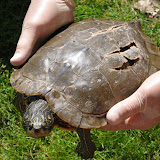
A mature Map Turtle, who has been nick-named “Legend”, came to the KTTC with a shell fracture in the spring of last year. Shortly thereafter she delivered 5 eggs into her water enclosure. Four of her oblong eggs were placed an incubator and left - untouched until the babies broke through their shells in the fall.
They remained in the incubator for approximately a week, living off their yolk sac. Once all remnants of the yolk sac were gone, they were transferred to a large water/land enclosure where they have been happily living since.

They are all thriving, and are reportedly 'good little eaters' - preferring live food such as crickets to commercial pellet food. They are due to be released this spring at the site where their mother Legend was injured last year. Had Legend not been brought to the KTTC for treatment these four may have never hatched or had a chance to help perpetuate the dwindling population of Map turtles in Ontario.

Additional images from this issue available on Picasa:
Kawartha Turtle Times 2009 Spring

Read more...

Winter 2009 Newsletter

Thursday, January 29, 2009

Our Turtles Need a New Space!

Although it will be months before turtles stir from their winter slumber to be seen once again in our wetlands – and on our roadways - the KTTC is busy planning to move for the second time.

In this issue:
Our Turtles Need a New Space!
Volunteers Needed
Spotlight on the Snapping Turtle (Chelydra serpentina)
Winter Slumber
Kids for Turtles Environmental Education
Thank you to Justine and Kazia!
Thank you to Goldbutton Studio!
2009 Calendar Campaign a Success!
Australia’s Bum-breathing Turtle Gets a Helping Hand
Rehabilitation Centre Development Workshop
T-Shirt Contest


Our Turtles Need a New Space!

Although it will be months before turtles stir from their winter slumber to be seen once again in our wetlands – and on our roadways - the KTTC is busy planning to move for the second time.

What are we looking for?

  • 1300 – 1800 sq/ft total
  • Minimum of of 1000 sq/ft without drywall (high humidity environment)
  • Optional drywalled office space
  • Concrete floor/sealable floor with floor drains
  • Reliable water supple
  • Electricity (we can wire it)
  • Insulated or insulatable (by us)
  • Bathroom and sinks
  • Propane / Natural Gas / Oil
  • Donated space preferred but not mandatory
We would like to thank our very generous landlords at Burman Fellows Group and Classy Chassis and Cycles. Their very kind contribution has led to the rehabilitation / release of over 100 native turtles! Their generosity continues as they have offered to help us move and re-wire our future home!

A new centre is a big step, but also an exciting opportunity. The only catch is that we need to be set up and ready to go before any turtles need our help this coming spring. If you would like to help us find a new space please email us at info@kawarthaturtle.org or call Jack (Riverside Park and Zoo Director) at 705-748-9301 ext.2303.


Volunteers Needed

The KTTC is looking for volunteers to help us expand our outreach program. In addition to raising awareness about the work of the KTTC, the committee will focus on educating the public about the status and ecological role of turtles native to Ontario. Educating the public is essential to reducing road mortality, assisting in the recovery of turtles native to Ontario, and to promoting turtle habitat protection and stewardship.

Volunteers are needed to help out at special events, write for the newsletter, update web content, design new promotional products, and a whole lot more. If you are interested in joining the committee or helping with other outreach activities please contact Gina at info@kawarthaturtle.org.


Spotlight on the Snapping Turtle (Chelydra serpentina)
By Rebecca Dolson


The Kawartha Turtle Trauma Centre would like to pay homage this month to the Snapping Turtle (Chelydra serpentina). In 2008, the Committee on the Status of Endangered Wildlife in Canada (COSEWIC) upgraded the Snapping Turtle to a species of 'special concern'.

This decision reflects current estimates of the Snappers range and abundance, in addition to its life history characteristics. For example, Snappers are long lived (it is thought Snappers could live to be 150!). Also, most female Snappers do not reach sexual maturity until at least 11 years old, and this is often an under-estimate. Their longevity and late age of maturity suggests that this species is very vulnerable to disturbance. So COSEWIC's decision to upgrade the status of this historical Canadian species is an important proactive step.

So what makes a turtle a Snapping turtle? Aside from being one of the most prehistoric looking animals in our Ontario landscape, they are also our largest reptile. Brownish in colour, they can reach over 50 pounds and 36 cm long. Their carapace (top shell) is serrated giving a dangerously pointy appearance reminiscent of dinosaurs! They have long claws on sturdy legs, and a jaw that can pack a powerful bite. Snapping turtles, unlike most turtles, have a reduced shell and cannot
protect themselves by pulling their head and legs into their shell. They have no natural predators in the water, but on land must protect themselves from predators the only way they can – by snapping. It is best to admire a Snapping turtle from a good distance.

Snappers prefer to live in swamps, weedy lakes, and backwater river areas, with lots of vegetation and a thick muddy bottom. Snapping turtles are both scavengers and predators, playing a significant ecological role by consuming detritus (decaying material), aquatic plants, fishes, tadpoles and frogs. Watch for them basking near the surface of bogs and swamps in early spring. The Snappers bask (lay for long periods in the sun) in order to warm themselves when they are cold. Turtles are ectotherms, meaning that they do not regulate the temperature of their bodies and so basking keeps them warm. In the winter, Snapping turtles avoid the cold by hibernating in the mud bottom of their swamp or river. They dig into the mud in early October and remain there until the following Spring (see Winter Slumber by Laurie Kryshka below for more details).

Breeding in Snapping turtles takes place in early spring (May) and occasionally throughout the summer. Females migrate to their preferred nesting grounds in early June and deposit 25-40 eggs in a nest. Nesting sites are typically found within 100 m of the shore in loose gravel-sand substrates, on gentle slopes. These well-drained substrates allow water and oxygen to move through the nest, helping the eggs develop. These sites are usually near roadways. A female that grew for at least 11 years before mating and laying eggs may be killed on the road the first time she looks for a nesting location. One study (Haxton et al. 2005) showed an annual road mortality rate of 30.5% for Snapping turtles, of which 24% were females.


Even if a female reaches a nesting site and lays eggs, between 20 and 100% of these nests can be dug up and the eggs eaten by raccoons and skunks. Many hatchlings are also eaten after hatching on their way to the water, or are picked off by predators in the water while they are still small. The sex of a baby snapping turtle is not genetically predetermined as in humans; turtle’s sex is temperature depen ent. The temperature of the nest influences how the eggs develop; at high and low temperatures female baby snapping turtles develop, while in moderate temperatures, males develop. Climate change threatens to alter the sex ratio of many organism that rely on temperature dependent sex determination, including turtles. Too few males or
females is not good for any population, especially long lived and slow responding species like the Snapping turtle.

Other threats include urban expansion and habitat loss; for example, when a wetland is filled in for housing developments. The Snappers diet has also given them a bad reputation. On rare occasions Snappers will eat small ducklings, goslings, and cygnets from the water surface when there is no other food available. For these reasons Snappers can be misunderstood and mistreated or killed by some misinformed people. The Snapping Turtle is also listed as a game species in Ontario. A valid Ontario Sport or Conservation fishing license allows a person to take up to two Snappers a day in season and possess a limit of five.

Given the immense challenges facing Snapping turtles, as well as Ontario's other turtles, we welcome the designation of Snapping turtles as a species of special concern by COSEWIC. By promoting awareness of this species, reducing unnecessary road mortality and increasing public perception of this relict species we can prevent the Snapping turtle from further population declines and conserve the species.


Winter Slumber
By Laurie Kryshka


All animals prepare for winter differently. Squirrels and chipmunks collect and hide food in the fall, many birds migrate or fly south, while other animals eat large amounts of food in the fall to gain body fat and then find a nice warm place to sleep through winter such as bears, frogs and turtles. Animals that do this are called “hibernators”. Hibernation is when an animal is in an inactive state for a period of time. To be a true hibernator the heart rate of the animal must slow down and their body temperature needs to drop down to near 0OC. That’s almost at the Freezing Point! This then makes it hard for the hibernator to wake up quickly. Even though bears are said to be hibernators they are not true hibernators because their body temperature does not drop very much, and they are easily awaken from their winter slumber. Turtles though are considered to be true hibernators and their hibernation is called Brumation.

All of Ontario’s turtles hibernate throughout winter and their hibernating sites are located usually at the bottom of ponds, lakes or deep under the mud. Doing this allows their body temperature and heart rate to drop so much that their body does not need to eat during the winter. Turtles are able to slow down their heart rate to almost nothing. Normally a turtle’s heart beats about 40 times a minute when basking in the sun in the summer, but during hibernation their heart beat drops down to about one beat every 10 minutes. WOW!

You may be asking yourself if turtles breathe air, how can they sleep all through winter under water? The answer to this puzzling question is just another amazing way turtles have adapted to their environment!

They are able to survive under water because the water that is at the bottom of the ponds and lakes contain more oxygen and are actually warmer than the surface water. To overcome their inability to breathe under water, turtles have adapted special tissue in their throat and tail opening that is able to take in oxygen that is in the water. This means that they are able to breathe through their throat and tail!

Hibernation is just one of the many vulnerable times in a turtle’s lifecycle. During hibernation their body slows so much that their immune system begins to shut down, which means that they are at high risk of getting really sick or even dying. Due to this sick or injured turtles should not hibernate and this is why the Kawartha Turtle Trauma Centre is so important. All of the sick or injured turtles that come into the Centre that do not heal in time for winter hibernation are kept at the Centre. We care for the turtles through winter so they will be healthy and ready to go once the spring and warm weather return.


Kids for Turtles Environmental Education
By Bob Bowles

Kids for Turtles Environmental Education, formed in 2006, is an outreach educational organization dedicated to increasing public awareness about the importance of preserving natural habitats and protecting the many species that live in these areas. The group promotes habitat preservation and the need for a responsible development process. They also promote healthy, active lifestyles, getting our younger generation out with their families communing with nature and learning about the world around them.

The name Kids For Turtles is symbolic in that turtles are among the few living remnants of the pre-historic era. Conversely, our children represent the future who will assume responsibility for it’s stewardship as future policy makers. Kids For Turtles started as a section of the Twin Lakes Conservation Club but have quickly grown now to a completely separate non-profit organization with charitable status and a membership of over 250 with many chapters in the area. The group now has their own office and an 11-member board of directors from every section of the educational community.

We are much more than just kids protecting turtles since our adult volunteers who include parents, active and retired educators and community leaders, give presentations to schools and community groups on invasive species, species at risk, vernal pools and many other environmental subjects including turtles and other reptiles. The group has formed partnerships with many leading environmental organizations including Ontario Nature. For more information on Kids For Turtles Environmental Education visit their website at www.kidsforturtles.com or email info@kidsforturtles.com. You can also call their office at 705-325-5386 (KFT6).

Kids for Turtles Winter Active Programs in 2009

We first read about the term Nature Deficit Disorder in Last Child in the Woods by Richard Louv published in 2005. He proposed the theory that there is a trend that children are spending less time outdoor resulting in a wide range of behavioral problems. He attributes this trend to parental fears that natural areas outdoor are not safe for children and they prefer them in the safety of their own homes. Here they are lured to the screen spending many inactive hours on the consumption of electronic media. CTV ran a story on this trend during the summer of 2007 and interviewed several experts.

They quoted Joe Doiron, senior policy analyst with the Public Health Agency of Canada’s healthy living unit who told them that the whole notion of free, unorganized play is going by the wayside and the trend now is mostly indoor organized activities. He adds, “children and youth are not as active today as they need to be to accrue all of the healthy benefits that they need for healthy growth and development.”

Professor Nathan Perkins of the University of Guelph has found that parents have very vague and powerful fears about letting their children play unsupervised outdoors. We have all watched news reports about a handful of serious crimes against children that seem to occur over and over again giving good reason for parental concerns.

Research by the environmental group Living Green has found that the average child in North America spends less than 15 minutes a day outside but up to 5 hours a day playing video games or watching television. These figures go up in the winter months. Public health staff has found that this lifestyle leads to childhood obesity and unhealthy living which leads to health problems, emotional problems, confidence issues and continuing unhealthy living throughout life.

Kids For Turtles Environmental Education has plans to reverse this tend this winter. We received funding from Good For Life to purchase 12 pairs of high quality children snowshoes this winter for our Snowshoeing Sunday outings. We have these available to groups or families free of charge and can provide leadership at special times this winter when snow condition are best. In order to make it more exciting for participants we are planning to install a winter bird feeder trail along the snowshoe route. Kids For Turtles feel that it is a good way to not only prevent nature deficit disorder and childhood obesity but to promote a healthy lifestyle outdoors.

About the author: Bob Bowles is a renowned naturalist, writer, photographer and professional environmental consultant, respected as an expert in all aspects of the environment. He is also the founder of the Orillia area Kids for Turtles, as well as a number of other naturalist groups.


A Special Thank You to Justine and Kazia!

We would like to extend a huge Thank You to Justine and Kazia Poser for their generous donation to the KTTC. Thanks to Justine and Kazia, we are able to purchase a much needed new fridge & freezer for the Turtle Centre. This allows us to store food and medicine for the turtles in our care.


Craft Sales to benefit KTTC

Local crafter Hilary of Goldbutton Studio is donating 10% of her sales to the Kawartha Turtle Trauma Centre. Hilary has several paintings for sale and also
molds polymer clay into little sculptures that may end up being earrings, necklaces, or other wearable art. You can visit her online shop at
www.goldbuttonstudio.etsy.com.


2009 Calendar Campaign a Success!

Since 2003 the Kawartha Turtle Trauma Centre has been selling calendars to raise funds for our turtle rehabilitation program. This year we raised a thousand dollars – that’s enough to 6 tanks (for housing painted, Blanding’s, wood, or map turtles) with proper filtering and lighting!

Over the years the calendars have been designed by the Wildlife Club at the University of Guelph, Lazer Graphics in Peterborough, and most recently by biologist Joe Crowley. Joe’s research for Ontario Nature was recently featured in ON Nature Magazine, available online at http://www.ontarionature.org/onnature/earthwatch.html#7.

Every year the calendars are marketed by a dedicated group of centre volunteers, as well as several local stores. We’d like to thank the stores listed below for their continued support of the Kawartha Turtle Trauma Centre:

• Animalia (901 Lansdowne St W)
• Have You Seen (321 Aylmer St N)
• Pet-a-Rama (1080 Lansdowne St W)
• Paulmac's (753 Lansdowne St W)
• Pet Valu (139 George St N)
• The Spill (414 George St N)
• Stickling's Bakery & Bistro (191 Charlotte St)
• Titles Bookstore (379 George Street N)
• Wild Rock Outfitters (169 Charlotte St)

The KTTC is recruiting volunteers to help with next year’s calendar campaign as well as other fundraising initiatives. If you are interested in helping us raise funds to continue our conservation work please consider volunteering with the Kawartha Turtle Trauma Centre by contacting us at info@kawarthaturtle.org.


Australia’s Bum-breathing Turtle Gets a Helping Hand
by Lesley Hale

In Central Queensland lies the Fitzroy River and the city of Rockhampton. Rockhampton is known as the Beef Capital of Australia, but its real icon was there long before the Brahmans moved in. It is the Fitzroy River turtle (Rheodytes leukops), a freshwater turtle that was only discovered in 1980 and is endemic to the Fitzroy Basin. This fascinating species is often referred to as a “bum-breather” due to its unique physiology which allows it to breathe through its bottom. This is known as cloacal respiration and there are other freshwater turtles that are known to have this physiology but none quite so defined as Rheodytes leukops. This turtle has been studied in recent years and it has been found that they can stay submerged for over a week by obtaining oxygen through their cloaca. Within its cloaca are highly-vascular, gill-like structures called papillae that facilitate aquatic gas exchange. It is believed they obtain up to 70 percent of their oxygen through this mode of respiration.

Due to its ability to stay submerged for long periods of time, most local residents are not aware of the existence of this turtle and certainly very few people have ever seen them. This evolutionary ability to stay submerged for long periods of time would likely give the species an advantage during its years as a hatchling and juvenile when they are vulnerable to multiple predators. However, this has given them no advantage to deal with the current threats that they face and they are now listed as a threatened species.

The Fitzroy River turtle is listed as ‘vulnerable’ and is facing a decline in population due to nest predation and habitat disturbance. Like so many other native species in Australia, the introduction of feral species such as foxes and cats has had a devastating impact. Turtle nests have always had natural predators such as water rats and goannas (lizards), but with the introduction of feral predators, the balance has been lost and the turtles are losing the battle of survival.

A local community organisation, Greening Australia, saw an opportunity to develop a project to conserve the threatened turtle. In partnership with scientists from the Environmental Protection Agency, Greening Australia developed a project that would address the threats such as nest predation and habitat disturbance.

With a team of over 30 local volunteers, ranging in age from 13 to 65, the project involved patrolling sections of the Fitzroy River which had nesting sites. From mid September to the end of November these sites were searched every morning at dawn for evidence of new nests. When new nests were found, a protective mesh was placed over the nest to keep predators from gaining access to the eggs buried in the sand.

In 2007 the team safely protected over 110 nests and with an average of 16 eggs per nest, it is estimated that over 1700 hatchlings reached the Fitzroy River. This was a huge success for the project and the nest protection patrols continue to this day. The 2008 nesting season saw similar success. In some cases the nests had to be relocated to safer nesting banks. This was due to either camping pressures or the turtle laying the nest too close to the river’s edge. In such cases, the eggs were carefully removed from the nest, measured, put in a box with sand and moved to a safer nesting bank. During the relocation it was imperative that the eggs not be rotated as this may have fatal results for the delicate embryo. The relocated nests had the same hatching success as stationary nests due to the delicate handling of the eggs.

Other aspects of the project include habitat restoration which involves fencing off nesting sites to restrict cattle access and weed removal to ensure the nesting banks are accessible for the turtles. The project received full cooperation from landholders to not only access nesting sites on their land, but also to erect fences where necessary.

The on-ground achievements of the project were very encouraging but perhaps the greatest achievements were those gained through raising awareness. Presentations on the Fitzroy River turtle project were given at local schools, community organisations, conferences and local events. In partnership with the Australian Freshwater Turtle Conservation and Research Association, workshops were held showcasing all the species of turtles living in the Fitzroy River. These live specimens were captive bred turtles and commonly used for education purposes across the state of Queensland. As the Fitzroy River turtle is normally such a shy and uncommonly seen animal, this workshop provided the local community the rare opportunity to see one up close and personal.

The local community were finally getting the opportunity to learn all about their local turtles and how they could help protect them. School children were excited to learn all about the “bum-breathing” turtle that lived in their local rivers. The project attracted media attention with spots on local and national news and the TV program Totally Wild. The Fitzroy River turtle is finally on the map and on the minds of Australians, both locally and nationally. The future is looking a little brighter for the shy turtle of the Fitzroy River.

QUICK FACTS
Name : Rheodytes leukops
Discovered: 1980
Status: Vulnerable
Distribution: Fitzroy Basin, Queensland, Australia
Size: 25cm
Appearance: Medium to dark brown with no
distinct markings; white ring around the eye
Reproduction: lays 12-20 eggs on sandy banks
from mid Sept to mid Nov; 2-3 clutches per season
Threats: nest predation, habitat disturbance; water
quality

About the Author:
Lesley Hale, a native to Belleville, Ontario, managed the Fitzroy River Turtle Conservation Project for 3 years in Queensland Australia. She is now volunteering with KTTC and helping with the Wood Turtle Recovery Strategy.


Rehabilitation Centre Development Workshop

The KTTC recently received a helping hand from Kip Parker, who lead a comprehensive workshop for board members and core volunteers on January 17 and 18. He shared many years of knowledge and experience in the field of wildlife rehabilitation, presenting on topics as diverse as the basics of rehabilitation, board roles and responsibilities, strategic planning, operating framework, volunteer management, centre design, fundraising and budgeting. The wisdom Kip has shared with us will be invaluable both during our current move and for our long-term planning.


T-Shirt Contest

The Kawartha Turtle Trauma Centre (KTTC) is having a t-shirt contest. Judging for the t-shirt contest will be based on originality (uniqueness of design), creativity, and best interpretation of the KTTC theme. Submissions for the contest will be accepted from February 1, 2009 to Friday, March 27, 2009. The person who submits the winning design will receive a t-shirt featuring thier design, a copy of The Great Big Book of Snakes and Reptiles (donated by Chapters), a pair of tickets to the Canadian Canoe Museum, and media publicity. The design will be posted on the KTTC website.

How to enter: Create a t-shirt design that will represent the KTTC. Entries should be submitted on 8 1/2 x 11 white paper, and they must be in color (no more than 2 colours should be used). A black and white sketch also must be submitted with the entry. The name, address and phone number of the artist must be written on the back of each entry submitted by mail. Entries may also be submitted by email and must include the same information. Entries must be received by 11:59p.m., Friday, March 27, 2009. There is a limit of one entry per person. By submitting a design, entrants agree to have their submissions appear on the KTTC website and the t-shirts to be produced. By accepting the prize, winners grant the KTTC permission and for the use of his/her name, likeness and biographical information and contest submission for advertising and promotional purposes without notice or additional compensation. All entries become the property of the KTTC and will not be returned. The KTTC t-shirt contest is open to all Ontario residents. Designs must be original artwork.

Please submit designs to: T-shirt Contest, Kawartha Turtle Trauma Centre c/o Riverview Park and Zoo, PO Box 4125, Peterborough ON, K9J 6Z5 or info@kawarthaturtle.org.


Additional images from this issue available on Picasa:
Kawartha Turtle Times 2009 Winter

Read more...

  © Blogger templates Newspaper by Ourblogtemplates.com 2008

Back to TOP